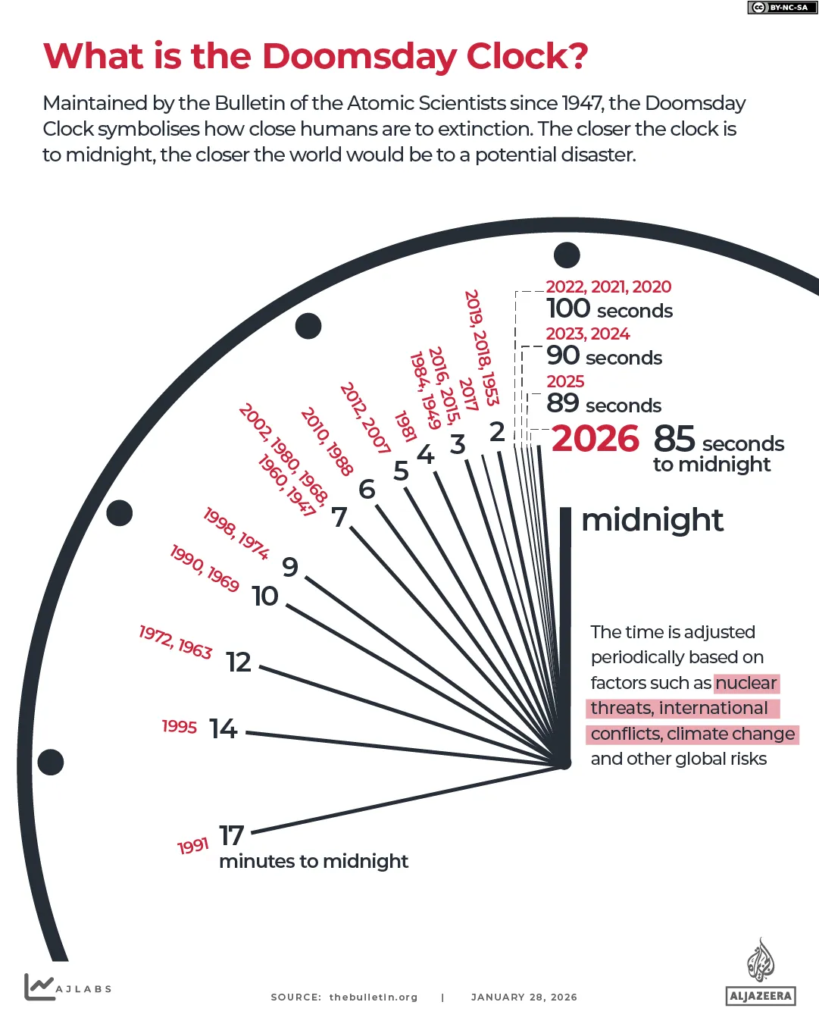
Scientists have warned that the world is closer than ever to catastrophe after the Doomsday Clock was set at 85 seconds to midnight for 2026, the closest it has been since the clock was created in 1947.
The warning came from the Bulletin of the Atomic Scientists, a nonprofit organisation founded by Albert Einstein and other leading researchers. In its annual assessment released on Tuesday, the group said global cooperation is rapidly declining while threats from nuclear weapons, climate change, biotechnology, and artificial intelligence are increasing.
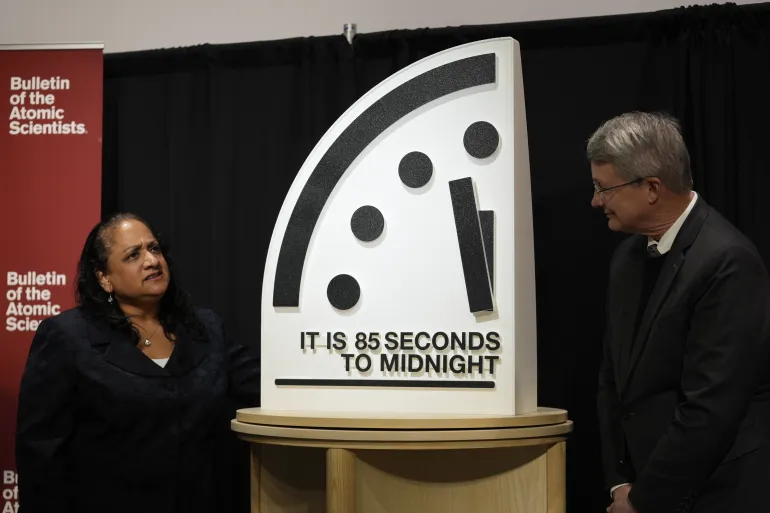
“The Doomsday Clock’s message cannot be clearer,” said Alexandra Bell, president and CEO of the Bulletin. “Catastrophic risks are rising, cooperation is falling, and we are running out of time. Change is possible, but the public must demand immediate action from world leaders.”
Growing Global Tensions
The Bulletin said major powers such as the United States, Russia, and China are becoming more aggressive and nationalistic. Long-standing international agreements are breaking down, and a new “winner-takes-all” competition between powerful nations is taking their place.
The assessment highlighted several conflicts from 2025, including:
- Russia’s war in Ukraine
- Armed clashes between India and Pakistan in May
- US and Israeli attacks on Iran in June
These conflicts, the scientists said, have increased the risk of wider wars and nuclear escalation.
Climate Crisis Worsens
On climate change, the Bulletin said global responses have been “deeply inadequate.” It criticised recent UN climate summits for failing to prioritise the phase-out of fossil fuels or strict monitoring of carbon emissions.
The group also accused US President Donald Trump of weakening climate action, saying his administration has aggressively rolled back renewable energy policies and climate protections.
However, the Bulletin acknowledged some positive developments. In 2024, renewable energy—especially wind and solar—grew at record levels. Together with nuclear power, clean energy sources accounted for more than 40 percent of global electricity generation for the first time.
What the Doomsday Clock Represents
The Doomsday Clock symbolises how close humanity is to self-destruction. Since its launch in 1947, the clock has ranged from 17 minutes to midnight (its safest point) to today’s 85 seconds, the most dangerous level ever recorded.
The safest moment came in 1991, after the Cold War ended and the US and Russia significantly reduced their nuclear arsenals. By contrast, in 1984, during heightened Cold War tensions, the clock stood at three minutes to midnight.
A Call for Cooperation
At the unveiling ceremony, Daniel Holz, a physics professor at the University of Chicago and chair of the Bulletin’s Science and Security Board, warned that rising nationalism and authoritarianism are worsening global dangers.
“Our biggest challenges can only be solved through trust and cooperation,” Holz said. “A world divided into ‘us versus them’ makes all of humanity more vulnerable