You can sense what IF is going to be almost immediately. The movie opens with whimsical home videos of an impossibly happy family, paired with soft narration about “the stories we tell ourselves.” Within seconds, most adults will realize where this is headed: that silent mother will soon be gone, the head scarf will appear, and the home movies will abruptly end. Children may be more surprised, especially if they were promised a zany comedy starring Ryan Reynolds alongside a fuzzy, Monsters, Inc.–style imaginary friend voiced by Steve Carell.
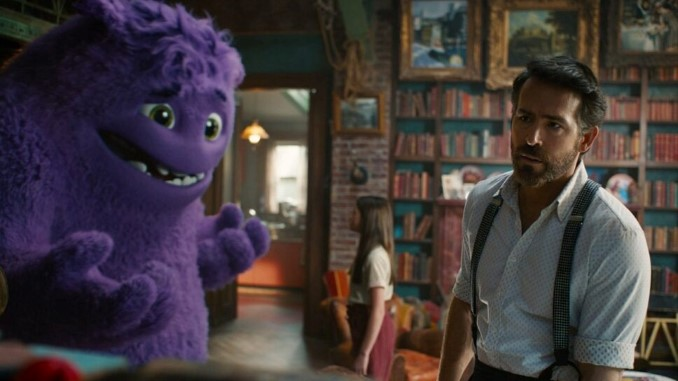
That purple imaginary friend is named Blue, supposedly because the child who invented him was colorblind. Never mind that a young child could easily name a color incorrectly without being colorblind, or that this explanation doesn’t reflect how colorblindness actually works. Written and directed by John Krasinski, IF seems to have learned only one lesson from Pixar: that it’s amusing—and eventually meant to be moving—when magical creatures operate under overly specific, mundane rules. Krasinski takes this idea painfully literally. Everything must be explained. Everything must have a system. The result is a movie so obsessed with organizing its whimsy that it forgets to build a believable world to contain it.
The story centers on 12-year-old Bea (Cailey Fleming), who travels to New York City to stay with her grandmother (Fiona Shaw) while her father (Krasinski) checks into the hospital. The film is oddly evasive about his condition, offering vague hints instead of clarity, as if withholding information is automatically more powerful. Instead, it just raises questions—especially for adults—about why a man seems to spend an entire week in the hospital before undergoing his supposedly life-saving heart surgery. At times, the movie even flirts with the unsettling suggestion that Bea’s father might be in a psychiatric ward, an unnecessarily dark implication for a family film.
Bea has already lost her mother to a brief, wordless cancer montage, and she has no patience for her father’s attempts at humor. She insists she’s no longer a child who needs everything turned into a game. Fleming plays Bea as calm, composed, and emotionally mature, which makes the film’s desire for her to “rediscover her inner child” feel oddly misplaced.
Enter Cal (Ryan Reynolds), a man Bea notices speaking to invisible figures in her grandmother’s apartment building. These figures turn out to be Imaginary Friends, or IFs—forgotten companions whose children have grown up. Blue is among them, along with Blossom (voiced by Phoebe Waller-Bridge), a delicate character who looks like she wandered in from an early Looney Tunes cartoon. The animation blending these cartoon figures into live-action environments is genuinely impressive, as is the cinematography by Janusz Kaminski, who bathes locations like Coney Island’s Luna Park in glowing, almost heavenly light. Visually, IF often looks beautiful.
Unfortunately, that technical polish doesn’t elevate the material beneath it. Where A Quiet Place used restraint and craft to enhance its emotional stakes, IF feels like a Pixar project perpetually on the verge of being reworked mid-production.
Bea soon helps Cal with his strange job: reuniting abandoned IFs with new children or, failing that, with their original creators, now grown. These IFs supposedly face eventual disappearance if they remain forgotten—a threat the movie invokes but never meaningfully explores. Krasinski loves rules, but not consequences. Despite lengthy explanations of how this world works, no one ever seems to know how to actually solve the problem they’re facing.
More troubling is the film’s misunderstanding of imaginary friends themselves. Imaginary friends are a normal, short-lived part of early childhood development, usually fading as children grow more social. IF reframes this process as a tragic loss tied to trauma or emotional neglect, transforming a common developmental phase into a mystical bond that is both deeply meaningful and strangely easy to forget.
Is it unfair to nitpick a children’s fantasy on psychological grounds? Not really. Inside Out, for example, used metaphor to help children understand their emotions. IF, by contrast, seems interested only in cheap emotional beats. It repeatedly dangles the possibility of another parental death without committing to exploring Bea’s pain in any meaningful way. Younger viewers could easily come away confused—not just about imaginary friends, but about how hospitals, illness, and caregiving actually function.
There is one standout sequence that briefly captures the magic the film is chasing. As Bea tours the IF retirement home, her imagination transforms the space through inventive camera work and visual effects. Rooms flip, characters emerge from paintings, and the scene erupts into a Tina Turner musical number pulled from Bea’s memory. For a moment, the film genuinely connects imagination with nostalgia in a way that feels alive and sincere.
Then it retreats back into bureaucratic whimsy and hollow sentimentality, insisting that adults would be profoundly moved if only they could see their imaginary friends again. The confusion at the heart of IF ultimately explains itself. What’s marketed as an all-ages celebration of childhood turns out to be something much simpler—and much smaller. Despite its aspirations, IF is a deeply baby-brained movie.