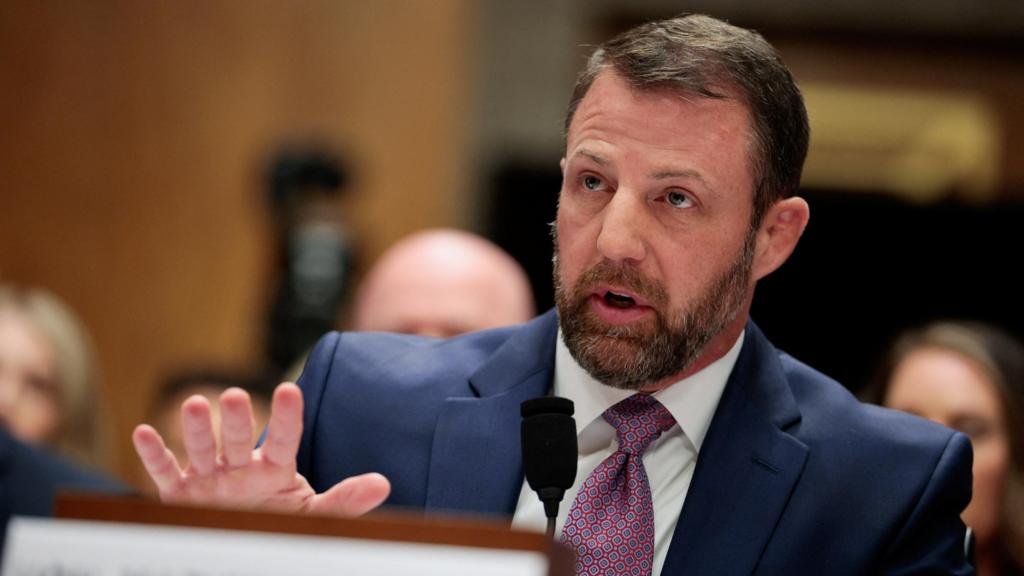
Introduction: When Rhetoric Doesn’t Match Reality
There’s a certain kind of politician who wraps every speech in the language of warriors — who speaks of sacrifice, combat readiness, and battlefield instincts as though they earned those words in uniform. Senator Markwayne Mullin of Oklahoma is one such politician, and now, as Trump’s pick to lead the Department of Homeland Security (DHS), that posture deserves serious scrutiny.
Here’s the core issue: Markwayne Mullin never served in the United States military. Not a day of active duty. Not a weekend of National Guard service. Yet his public statements, his combative congressional hearing performances, and his hyper-masculine bravado consistently project the image of a man with military credentials he simply doesn’t have.
This isn’t a trivial optics problem. It’s a question of authenticity, leadership credibility, and what kind of standard we hold officials to when they seek to run the nation’s most powerful domestic security apparatus.
Who Is Markwayne Mullin?
Before diving into the military posture issue, it’s worth knowing who Markwayne Mullin actually is.
Mullin is a Republican senator from Oklahoma who previously served in the U.S. House of Representatives from 2013 to 2023. He was elected to the Senate in 2022 to fill the seat vacated by Jim Inhofe. By profession, he is a plumbing contractor and former mixed martial arts (MMA) fighter — a background he references frequently when projecting physical toughness.
Trump nominated Mullin to serve as Secretary of Homeland Security, a role that oversees immigration enforcement, border security, FEMA, the Secret Service, TSA, and the Coast Guard — among others. It is, without exaggeration, one of the most consequential national security positions in the U.S. government.
The Military Service Record: What the Facts Say
Let’s be direct: Markwayne Mullin has no military service record.
He did not serve in the Army, Navy, Air Force, Marines, Coast Guard, or any reserve or National Guard unit. This is publicly documented and not in dispute. Mullin himself has never claimed to have served — he simply allows the persona he projects to fill in that gap for audiences who assume otherwise.
His MMA background is real. His work as a plumber is real. His toughness, in the physical sense, may well be real. But physical toughness and military service are not the same thing, and conflating the two — whether intentionally or through omission — misleads the public.
When politicians appropriate military language and culture without having served, they engage in a form of “stolen valor by implication” — not lying outright, but constructing an image that borrows credibility they didn’t earn.
The Pattern: Talking Like a Veteran Without Being One
Aggressive Congressional Performances
Mullin became a national figure, at least in viral terms, after his extraordinary confrontation with Teamsters President Sean O’Brien during a Senate hearing in September 2023. Mullin stood up, removed his watch, and effectively challenged O’Brien to a physical fight — on the floor of the U.S. Senate.
It was a moment that many observers described as theatrical macho-ism. Others admired it. What it signaled, regardless of interpretation, was a governing style rooted in physical dominance and aggression — language borrowed from the culture of combat, used in a context that had nothing to do with warfare or security.
Border Policy Rhetoric
On immigration and border security — the central issues of the DHS role — Mullin has consistently used military framing. He talks about “securing the border” with a vocabulary of missions, threats, and confrontations. He positions himself as someone who understands hostile environments and tactical responses.
Critics argue that this kind of framing — while politically effective — can distort policy discussions. Treating migration as a battlefield scenario has real-world consequences for how enforcement agencies behave and how policy is written.
The “Tough Guy” Brand in Washington
Mullin has cultivated what political analysts sometimes call a “tough guy” brand. His MMA past is weaponized rhetorically in settings where no one is actually going to fight — congressional hearings, TV interviews, campaign events. It’s a performance of strength that mimics the authority of military experience without requiring any of its actual sacrifice or discipline.
This is not unique to Mullin. A number of politicians who never served use martial language freely. But when someone is being nominated to lead an agency that employs over 260,000 personnel and manages real-world security threats, the performance becomes policy — and that’s where it matters most.
Why This Matters for the DHS Role
Understanding the Department of Homeland Security
The DHS is not a minor cabinet position. It was created after 9/11 specifically to coordinate America’s domestic security infrastructure. Its secretary must:
- Oversee disaster response via FEMA
- Manage immigration enforcement through ICE and CBP
- Supervise the Transportation Security Administration (TSA)
- Coordinate with the intelligence community
- Lead cybersecurity efforts through CISA
- Command the U.S. Coast Guard
This requires an understanding of both civilian governance and security operations at an extremely high level of nuance.
Why Military Experience — or Its Absence — Matters
Military service doesn’t automatically make someone qualified for civilian leadership roles, and its absence doesn’t disqualify anyone. Many exceptional DHS leaders and cabinet officials never served. That is not the issue here.
The issue is performing military credibility you don’t have to influence public trust. When a nominee for a national security role projects a military-adjacent persona without the actual service record, it raises legitimate questions:
- Does it affect decision-making? Leaders who believe their own performance of toughness may default to escalation when de-escalation is warranted.
- Does it affect agency culture? Personnel who have actually served — and the DHS employs many veterans — may struggle to respect a leader whose military posture is entirely manufactured.
- Does it mislead the public? Voters who associate military demeanor with security expertise may be forming trust based on a false impression.
How the Public and Media Should Respond
Fact-Checking Public Persona Is Essential
In an era of persona-driven politics, fact-checking goes beyond policy positions. It includes examining whether an official’s public image is grounded in reality. When a politician talks about combat readiness, border “missions,” or confronting threats — and has no military background — journalists and voters have a responsibility to note the gap.
Questions the Senate Should Ask During Confirmation
If Mullin’s nomination moves forward to a Senate confirmation hearing, the following questions are fair game:
- What specific training or experience qualifies you to command a 260,000-person security agency?
- How will you approach relationships with the Coast Guard and other uniformed branches within DHS if confirmed?
- How do you distinguish between border enforcement as law enforcement versus border enforcement as military operations?
- What is your approach to FEMA disaster response, which requires coordination, empathy, and logistics — not aggression?
These aren’t gotcha questions. They are baseline competency questions that any DHS secretary nominee should answer clearly.
Practical Tips: How to Evaluate Political Nominees
Whether you’re a voter, journalist, or policy advocate, here’s how to cut through persona-driven politics when evaluating any nominee:
- Separate the brand from the record. What has the person actually done? What agencies have they managed? What crises have they navigated?
- Check military service claims directly. The National Personnel Records Center (NPRC) processes military record requests. Claims of service can be verified.
- Watch for language without substance. Phrases like “I know how to fight” or “I’ll secure the border” are not policy positions. Push for specifics.
- Look for experience relevant to the role. For DHS, that includes emergency management, law enforcement coordination, immigration law, and federal agency leadership.
- Ask who vouches for them — and why. Political endorsements and personal loyalty to a president are not qualifications. Look for endorsements from domain experts.
The Broader Trend: Machismo Politics and National Security
Mullin is part of a broader trend in American politics where physical toughness has become a stand-in for policy competence, particularly on security issues. This trend is bipartisan in some respects, but it has been especially pronounced in right-wing politics over the past decade.
The problem isn’t that strength is irrelevant — it isn’t. But national security leadership requires:
- Strategic thinking, not just confrontation
- Coalition building, not just dominance
- Nuanced threat assessment, not just aggression
- Legal and constitutional literacy, not just bravado
A DHS secretary who performs military toughness without understanding the institutional culture, legal frameworks, and human complexity of the department’s work is a liability — regardless of their physical fitness or aggressive style.
Conclusion: Accountability Before Confirmation
Trump’s nomination of Markwayne Mullin to lead the Department of Homeland Security raises legitimate concerns — not because he’s a fighter, and not because he lacks a military uniform, but because the gap between his projected persona and his actual qualifications deserves honest examination.
Talking like you’ve served when you haven’t is not valor. It’s a performance. And when that performance is used to build political credibility for one of the nation’s most sensitive leadership roles, the public deserves to know the difference.
Before the Senate confirms or rejects this nomination, the hearings must go beyond applause lines and partisan posturing. The DHS touches the lives of every American — from natural disasters to immigration enforcement to airport security. It needs a leader whose credentials are real, whose competence is documented, and whose persona reflects the actual demands of the role.