Introduction: When the Senate Becomes Must-Watch TV
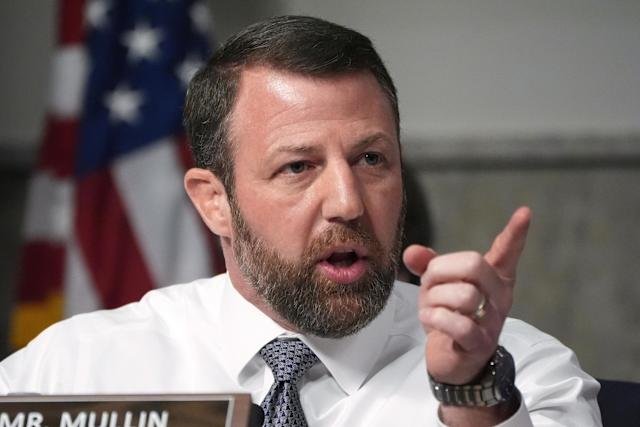
Senate confirmation hearings rarely go viral. But on March 18, 2026, Senator Markwayne Mullin’s testimony before the Senate Homeland Security and Governmental Affairs Committee became the kind of political spectacle that stops your scroll and demands your full attention.
Trump’s pick to lead the Department of Homeland Security found himself tongue-tied, backtracking, and unable to clearly account for his own international travel record — all while being fact-checked in real time by a fellow senator. And that was just one of several fires he had to put out during a hearing that went sideways almost from the opening gavel.
What exactly happened? Why does it matter? And what does a floundering confirmation hearing tell us about the man being considered to oversee 260,000 employees and more than 20 federal agencies? Let’s break it all down.
Who Is Markwayne Mullin? A Quick Background
Before diving into the meltdown itself, it helps to understand who Markwayne Mullin is — and why this hearing was always going to be high-stakes.
Mullin is a Republican senator from Oklahoma, a former professional mixed martial arts fighter with a 5-0 record, and the man who took over and expanded his family’s plumbing business before entering Congress in 2013. He served a decade in the House before moving to the Senate, where he has become a close ally of President Donald Trump.
Trump nominated Mullin earlier in March 2026 to replace Kristi Noem as DHS Secretary after firing Noem amid a string of controversies, including a $220 million ad campaign and her handling of immigration enforcement that resulted in the deaths of two U.S. citizens in Minneapolis.
Mullin, described by colleagues as tough, aggressive, and fiercely loyal to Trump, was expected to represent a fresh start for the department. Wednesday’s hearing quickly complicated that narrative.
The Moment Markwayne Mullin Went Tongue-Tied Over Foreign Travel
The confirmation hearing’s most viral moment arrived when Senator Gary Peters (D-Mich.), the ranking Democrat on the committee, began a straightforward line of questioning about Mullin’s international travel history.
Peters asked a seemingly simple question: had Mullin ever traveled to a foreign country outside of family vacations?
Mullin initially claimed he had not — that his overseas trips were limited to family vacations and church mission work. Then Peters started fact-checking him. In real time.
Peters pressed Mullin about a specific and well-documented trip to Afghanistan in 2021, during the chaotic U.S. withdrawal, when Mullin attempted to fly into the country to help rescue American allies. That mission was covered extensively by national news outlets at the time.
Faced with this, Mullin scrambled. He claimed he thought Peters was “referring to a different time,” then acknowledged the 2021 trip was real and well-documented. Satisfied, Peters responded that Mullin had indeed traveled overseas “despite your previous comment” — a polite but pointed way of saying he had just been caught in a contradiction.
It didn’t stop there.
“It’s Classified, Sir” — The Azerbaijan Problem
Later in Peters’ questioning, Mullin was pressed about the nature of a trip to Georgia and Azerbaijan. Rather than answer, he stonewalled with a phrase that quickly became a punchline: “It’s classified, sir.”
The problem? Mullin is not a veteran. He has no publicly known background in defense contracting or intelligence work. Before entering Congress, he ran a plumbing business in Oklahoma. Yet his travel record apparently contains missions whose details he says he cannot legally disclose.
This has puzzled colleagues for years. According to reporting from the Washington Post and Axios, Mullin has privately hinted to multiple lawmakers that he carried out dangerous security work in Middle Eastern war zones before entering Congress — work he has never disclosed publicly, never mentioned in any of his five congressional campaigns, and never fully explained even when pressed.
When asked about it in a 2023 Senate Republican podcast, Mullin said simply: “There’s another side of my bio that I don’t ever talk about. I had to go do something overseas. And when I went over there, I always let my beard grow out before.”
No follow-up. No details. Just vibes and a beard.
“Where Did You Smell War?” — Peters Keeps Pressing
One of the most cutting exchanges of the hearing came when Peters asked Mullin directly: “Where did you smell war, sir?”
The question was a reference to a Fox News appearance earlier in March 2026 where Mullin, speaking about the Iran war, said: “War is ugly, it smells bad.” The comment was widely noted because Mullin has never served in the military and — on the public record at least — has no confirmed experience in active combat zones.
Mullin told the committee he was involved in a 2015 trip where he was asked to train with “a very small contingency” and go to “a certain area.” He offered almost no specifics, again invoking classification.
“I’ve spoken generally about my experiences, but I’ve never spoken specifically on details, on dates, or on the mission,” he said.
Peters’ expression said what many were thinking.
Rand Paul Opens the Hearing With Fireworks
Even before Peters got his turn, the hearing opened with fireworks — courtesy of committee chairman Senator Rand Paul (R-Ky.), who has a well-documented history of difficult relations with Mullin.
Paul opened by confronting Mullin over reported comments that Mullin had called him a “freaking snake” and said he “understood why” Paul’s neighbor attacked him in 2017. That assault left Paul seriously injured, requiring surgery.
Mullin did not apologize. His response: “It seems like you fight Republicans more than work with us.” He acknowledged not getting along with Paul but said it wouldn’t prevent him from doing the job.
Paul’s reply was pointed: “The record will show a lack of contrition, no apology, and no regrets for your support — you completely understand the violence that was perpetrated on me.”
Paul then played a video of the now-infamous 2023 Senate hearing in which Mullin challenged Teamsters President Sean O’Brien to a fistfight, inviting him to step outside. That clip alone would have dominated any other news day.
Other Flashpoints in the Hearing
The Mullin confirmation hearing was not short on memorable moments. Here’s a quick summary of other notable exchanges:
- The 2020 election question: Senator Elissa Slotkin (D-Mich.) asked directly who won the 2020 election. Mullin, who voted to overturn the results, refused to give a direct answer. His response: “We know that President Joe Biden was sworn into office.”
- ICE and warrants: Mullin told the committee he would require judicial warrants for immigration agents to enter private homes or businesses — a potential shift from his predecessor Kristi Noem’s approach, and an answer that briefly made him look reasonable.
- Polling place deployment: Mullin said DHS officers would only be deployed to polling places if there was a specific, credible threat — not for general intimidation. This followed Trump’s call to “nationalize” elections.
- The Rand Paul chair block: Paul also blocked Senator Katie Britt (R-Ala.) from introducing Mullin at the hearing — an unusual procedural move that underscored just how fractured Republican relations are heading into this nomination.
- FEMA restructuring: Mullin said he favors restructuring FEMA and ending certain programs put in place by Noem.
What Does This Hearing Tell Us About Mullin’s Qualifications?
The tongue-tied Markwayne Mullin moment over his travel history is more than just an embarrassing clip. It raises genuine questions about the nature of his claimed national security experience.
Here is what is known for certain:
- Mullin has traveled overseas on standard congressional delegation trips to countries including Afghanistan, China, Georgia, and Azerbaijan.
- He attempted to fly into Afghanistan in 2021 during the U.S. withdrawal to help rescue American allies.
- Before Congress, his office says he did “mission work” and mentored returning U.S. troops from a Christian perspective.
Here is what remains unclear:
- The nature of any pre-congressional overseas work.
- The basis for his repeated references to being in combat-adjacent situations.
- The specifics of classified trips he has alluded to but refused to detail.
Like his predecessor Noem, Mullin has no formal background in law enforcement or immigration policy. Whether his mysterious overseas résumé closes that gap — or simply inflates his image — is something the Senate will have to weigh.
Why the DHS Chair Matters Right Now
The stakes for whoever runs DHS are unusually high at this moment. Under Noem, the department:
- Carried out a mass immigration enforcement surge that resulted in deaths.
- Oversaw arrests of U.S. citizens and asylum seekers with legal status.
- Has been partially shut down since February 14, 2026, amid a congressional funding impasse.
- Lost significant cybersecurity capacity through cuts to CISA (the Cybersecurity and Infrastructure Security Agency).
Mullin now inherits all of this — if confirmed. He will answer to a department with more than 260,000 employees formed in the wake of September 11 to protect U.S. borders and prevent terrorist attacks. That is a serious job for anyone, let alone someone whose main pre-political credential is running a plumbing company in Tulsa.
Republicans hold an 8–7 edge on the committee. If Paul votes against Mullin, his path gets considerably harder.
Practical Takeaways: What to Watch Next
If you are tracking this story, here are the key things to follow in the coming days:
- Rand Paul’s vote: Does Paul ultimately block Mullin at the committee level, or does he fall in line? His opening remarks signaled deep personal hostility.
- The classified travel question: Will any senator formally request a classified briefing on Mullin’s overseas activities before voting?
- DHS shutdown: The department has been partially shut down for over a month. How Mullin plans to resolve the funding impasse is a critical early test.
- Immigration policy signals: Mullin’s statement on judicial warrants was notable. Whether that represents a real policy shift or just smart testimony will become clear once he is in the chair.
- The full Senate vote: Even if the committee advances him, Mullin needs majority support in the full Senate. John Fetterman (D-Pa.) has signaled openness, which could be crucial.
Conclusion: A Rocky Start for the DHS Nominee
The image of a tongue-tied Markwayne Mullin unable to account for his own travel history — fumbling through classifications, backtracking on earlier statements, and getting corrected by Gary Peters in front of a live C-SPAN audience — is not the image his backers wanted leading into a vote.
Whether it ultimately derails his confirmation is another question. Washington has a short memory, and party discipline often wins out over embarrassment. But the hearing exposed real vulnerabilities: an inconsistent account of his overseas experience, a hostile relationship with his committee chairman, and an inability to give clean, direct answers to basic factual questions.
For a man being considered to run one of the largest and most consequential departments in the federal government, those are not small concerns.
Stay up to date on the Mullin confirmation vote and what it means for the future of DHS — bookmark this page and check back for updates as the story develops.